
Technology has never been more capable, or more complex. A single medical device can combine acoustics, optics, electronics, embedded software, machine learning, biology, human factors, regulation and manufacturing. No one person can be an expert in all of it.
The surgeon and author Atul Gawande put it plainly:
“The volume and complexity of what we know has exceeded our individual ability to deliver its benefits correctly, safely, or reliably.”
Atul Gawande, The Checklist Manifesto (2009)
So we build teams of specialists. Each person plays a critical but specific role. That is exactly as it should be, and it creates a new problem: somebody has to hold the whole thing together.
Many specialists, many languages
Put an acoustician, a firmware engineer, a clinician, a regulatory specialist and an investor in the same room, and they will look at the same result and see different things.
- Communication styles differ. One person writes a forty-page report; another sends a one-line message; a third mentions the critical caveat in passing at the end of a meeting.
- Interpretation of data differs. “Significant” means one thing to a statistician, another to a clinician and a third to a commercial team.
- The importance of a result differs. A 2 dB improvement in signal-to-noise can be a breakthrough to the acoustics team and irrelevant to the product if it costs a day of battery life.
None of these people are wrong. They are seeing their part of the picture clearly. The psychologist Daniel Kahneman described our natural tendency to judge only from the information in front of us as “what you see is all there is”. In a specialist team, everyone is subject to it, from a different angle.
Sometimes the gap between those angles is expensive. In 1999, NASA lost the Mars Climate Orbiter because one team provided thruster data in imperial units (pound-force seconds) while the navigation software expected metric units (newton-seconds). The engineering on both sides was competent. The failure lived in the interface between teams, and nobody owned the thread that ran across it.
The organisation becomes the product
In 1968, the computer scientist Melvin Conway made an observation that is now known as Conway’s Law:
“Organizations which design systems … are constrained to produce designs which are copies of the communication structures of these organizations.”
Melvin E. Conway, How Do Committees Invent?, Datamation (1968)
If two teams barely talk, the interface between their subsystems will be weak. If everything has to pass through one overloaded person, so does every design decision. The way a team communicates is not separate from the engineering; it shapes it.
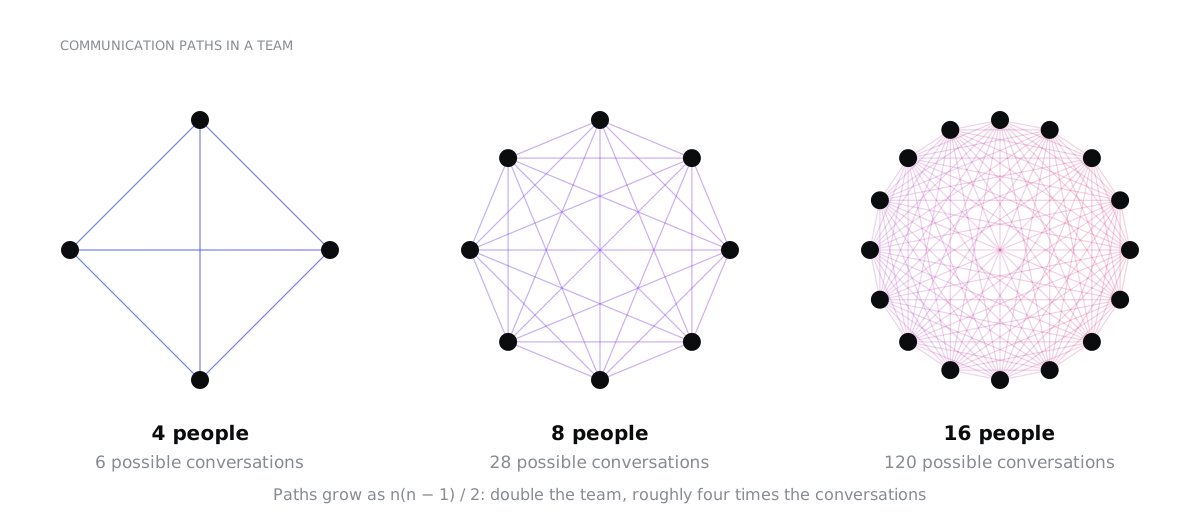
And communication does not scale gently. The number of possible conversations in a team grows roughly with the square of its size.
The cost of cross-talk
When speed, risk and complexity are all high, small misunderstandings compound: work is duplicated, decisions are revisited, a requirement is discovered late, a test has to be repeated, a design has to be reopened. Each one costs time and money, and often both.
The pattern is well documented. A study of large IT projects by McKinsey and the University of Oxford found they ran on average 45% over budget and 7% over time, while delivering 56% less value than predicted. Hardware and medical device programmes have their own versions of the same story.
The instinctive fix, adding more people, rarely works. Fred Brooks summarised decades of experience in what became known as Brooks’s Law:
“Adding manpower to a late software project makes it later.”
Frederick P. Brooks Jr., The Mythical Man-Month (1975)
More people means more conversations, more onboarding and more interfaces. What a struggling programme usually needs is not more hands, but a clearer thread.
Being the smartest in the room is not enough
Deep expertise is essential. But a brilliant specialist answering the question in front of them is not the same as making the right decision for the product or the business.
Good technical decisions under uncertainty depend on judgement that comes from experience: having seen how a choice made in month two plays out in month eighteen, in verification testing, in a clinical study or on a production line.
Jeff Bezos described one of the most useful distinctions in his 2015 letter to Amazon shareholders. Some decisions, he wrote, are “consequential and irreversible or nearly irreversible – one-way doors”, and deserve careful, deliberate thought. Most are reversible “two-way doors” that should be made quickly. Knowing which is which, and not treating every decision the same way, is a skill learned over years.
Experience also means planning for what you cannot predict. Dwight D. Eisenhower captured it in a 1957 speech: “Plans are worthless, but planning is everything.” The value is not in the document; it is in having thought through the dependencies and risks before they arrive.
And it means honesty about the data. After the Space Shuttle Challenger disaster, Richard Feynman wrote in his appendix to the Rogers Commission report:
“For a successful technology, reality must take precedence over public relations, for nature cannot be fooled.”
Richard P. Feynman, Appendix F, Report of the Presidential Commission on the Space Shuttle Challenger Accident (1986)
Engineers’ concerns that are not heard, or not weighted properly, are among the most dangerous risks in any technical programme.
The red thread
In Scandinavian languages there is a lovely expression: den røde tråden, the red thread. It is the line that runs through a story and makes it hang together. In an engineering programme, someone has to own it.
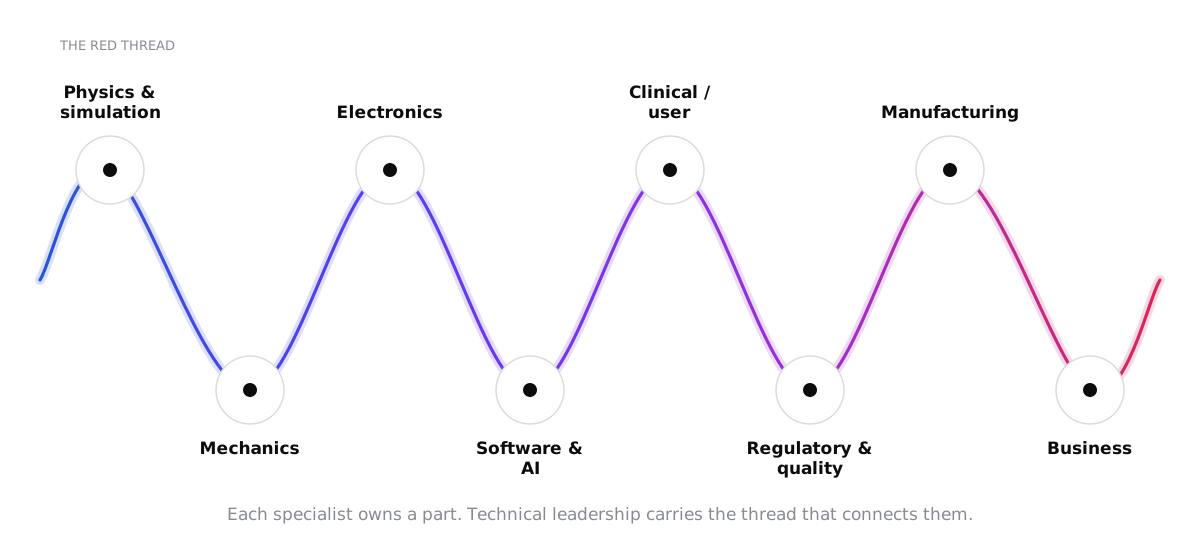
Consider one decision in an ultrasound device: the centre frequency of the transducer. It sets the trade-off between resolution and penetration (physics). It shapes the element size, the array and the cable (mechanics). It drives channel count, power and heat (electronics). It changes the computing load and the data that algorithms are trained on (software and AI). It determines which patients and organs can be imaged (clinical). It affects acoustic output testing and safety limits (regulatory). It influences yield and cost (manufacturing). And it moves the price point and the market (business).
No specialist sees all of those consequences from their own seat. Broad technical leadership does. Fred Brooks called this conceptual integrity, and argued that it “is the most important consideration in system design.”
In practice, that leadership:
- Connects the dots early, spotting how a choice in one discipline will land in another before it becomes a problem.
- Translates between specialists, and between engineering, clinicians, investors and the board.
- Designs the interfaces deliberately, both in the product architecture and in how the teams work together.
- Makes data comparable: shared definitions, units, success criteria and test methods.
- Separates one-way doors from two-way doors, moving fast where decisions are reversible and slowing down where they are not.
- Keeps the risks visible and honest, so that reality, not optimism, drives the plan.
Signs your team needs a red thread
- Decisions are often reopened, or made twice by different groups.
- Integration is where surprises appear, late and expensively.
- Specialists are excellent, but nobody can explain the whole system and its trade-offs on one page.
- Business and technical conversations happen in different rooms, with different numbers.
- The plan assumes everything goes right.
How we help
We provide senior technical leadership for medtech and deep-tech teams, as an embedded part of your team or as a regular advisor. Drawing on work across ultrasound, optical sensing, drug delivery, robotics and AI, from first principles to clinical trials, we help teams see the whole system, make the hard calls with confidence, and keep the red thread intact from idea to evidence.
If your programme is complex, fast-moving and high-stakes, let’s talk, or read more about our technical leadership service.
Sources
- Atul Gawande, The Checklist Manifesto: How to Get Things Right, Metropolitan Books, 2009.
- Daniel Kahneman, Thinking, Fast and Slow, Farrar, Straus and Giroux, 2011.
- NASA, Mars Climate Orbiter Mishap Investigation Board Phase I Report, 1999.
- Melvin E. Conway, “How Do Committees Invent?”, Datamation, April 1968.
- M. Bloch, S. Blumberg and J. Laartz, “Delivering large-scale IT projects on time, on budget, and on value”, McKinsey & Company with the University of Oxford, 2012.
- Frederick P. Brooks Jr., The Mythical Man-Month: Essays on Software Engineering, Addison-Wesley, 1975.
- Jeff Bezos, Letter to Amazon shareholders, 2015.
- Dwight D. Eisenhower, remarks at the National Defense Executive Reserve Conference, 14 November 1957.
- Richard P. Feynman, “Personal observations on the reliability of the Shuttle”, Appendix F, Report of the Presidential Commission on the Space Shuttle Challenger Accident, 1986.